What a voice interval timer does
A basic interval timer beeps when a work period or rest period ends. A voice timer tells you what is happening: which exercise is next, how much time is left, when rest starts. The point is not novelty. When your hands are on the floor or your heart rate is up, you cannot read a screen, and a beep does not tell you which move comes next.
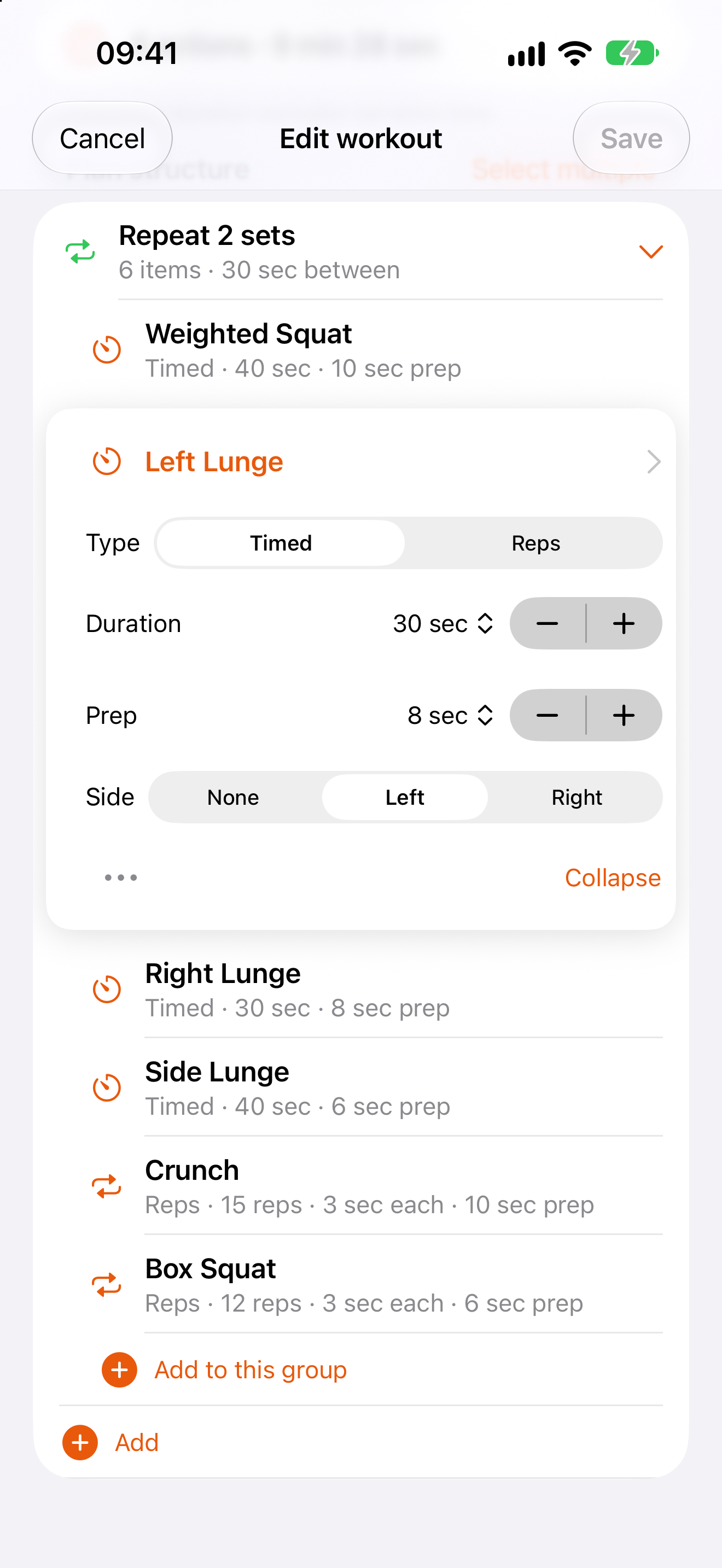
In Swayni, every exercise, set, round and rest is announced out loud, with an up-next preview before the rest ends. Exercises can be timed or counted in reps, and holds, rounds and rests can be nested however you like, with a full timeline preview and estimated time before you start.
Choosing your work and rest
A common starting pattern is 30 seconds of work followed by 10 seconds of rest, which is what the routine below uses. Longer work with shorter rests is harder; shorter work with longer rests is gentler. There is no universal ratio, so pick what lets you keep decent form until the last interval.
Sample routine: Standing Punch Flow
One of Swayni’s official workouts: punches and arm pulses on a lively rhythm, no jumping and no floor. It is 30 seconds of work with 10 seconds of rest, about 6 minutes in total. For something more demanding, the 7-Minute Full-Body Circuit uses the same 30/10 structure with 13 moves.
| # | Move | Work | Rest after |
|---|---|---|---|
| 1 | March in Place | 30 sec | 10 sec |
| 2 | Standing Punches | 30 sec | 10 sec |
| 3 | Arm Pulses | 30 sec | 10 sec |
| 4 | Standing Punches | 30 sec | 10 sec |
| 5 | Wall Push-Up8 sec to get into position | 10 reps (about 30 sec) | 10 sec |
| 6 | Standing Punches | 30 sec | 10 sec |
| 7 | Standing Torso Rotation | 40 sec | 10 sec |
| 8 | Arm Openers | 30 sec | 10 sec |
| 9 | Standing Y Raise | 30 sec | — |
Total time: 6:08
How to do each move
March in Place
- Stand tall and begin marching at a comfortable pace.
- Lift each knee only as high as you can without leaning back.
- Let your arms swing naturally and gradually warm up.
Form cue: Step softly and breathe normally. Slow down or reduce the knee lift if you feel unsteady.
What Swayni says: “Step light and steady” · “Let your arms swing”
Standing Punches
- Stand in a staggered stance with soft knees and your fists guarding your chin.
- Punch forward with alternating hands, rotating your shoulders and upper body.
- Snap each fist back to your chin after the punch and keep a steady rhythm.
Form cue: Don't lock your elbows at full extension and bring your fists back quickly. Keep a pace where your breathing stays controlled.
What Swayni says: “Punch and snap back” · “Rotate through your shoulders”
Arm Pulses
- Stand tall and raise your arms out to the sides at shoulder height, palms down.
- Keeping your arms straight, pulse them up and down in small, quick movements.
- Hold the rhythm as your arms start to burn without letting them drop.
Form cue: Keep your shoulders down and away from your ears. If you can't hold it, lower your arms slightly and keep going.
What Swayni says: “Arms at shoulder height” · “Small, quick pulses”
Wall Push-Up
- Face a wall and place your hands on it at shoulder height, slightly wider than your shoulders.
- Step your feet back half a step so your body forms a slanted line from head to heels.
- Bend your elbows to bring your chest toward the wall, then push back to the start.
Form cue: Keep one straight line without sagging or piking. The farther your feet are from the wall, the harder it gets.
What Swayni says: “Keep one straight line” · “Push back to the start”
Standing Torso Rotation
- Stand with feet hip-width apart and arms relaxed or crossed over your chest.
- Rotate your torso gently to one side, then the other.
- Keep your hips facing forward as you turn.
Form cue: Rotate through your upper back rather than forcing the movement from your lower back.
What Swayni says: “Rotate from your upper back” · “Hips stay facing forward”
Arm Openers
- Stand tall and raise your bent arms in front of your chest at shoulder height.
- Pull your elbows back twice, squeezing your shoulder blades together.
- Then open your straight arms out to the sides and bring them back in.
Form cue: Keep a steady rhythm without flinging your arms. Let your upper back do the work and don't arch your lower back.
What Swayni says: “Elbows back” · “Squeeze your shoulder blades”
Standing Y Raise
- Stand hip-width with soft knees and hinge slightly forward from the hips, back flat.
- With straight arms and thumbs up, raise your arms diagonally forward into a Y.
- Squeeze your shoulder blades briefly at the top, then lower slowly.
Form cue: Lift from your upper back instead of swinging, and only go as high as you can without shrugging. Keep your back flat throughout.
What Swayni says: “Thumbs up into a Y” · “Squeeze at the top”
Pacing tips for interval work
- Keep your breathing controlledFor punches, do not lock your elbows at full extension, bring your fists back quickly, and keep a pace where your breathing stays controlled.
- Shoulders downFor arm pulses, keep your shoulders away from your ears. If you cannot hold it, lower your arms slightly and keep going.
- Use the rest to resetA 10-second rest is for a breath and a look at what is coming next. That is what the up-next call is for.
Build your own intervals in Swayni
Beyond the ready-made workouts, you can arrange your own: prep time, exercises, rounds and rests in the exact flow you want. Your exercises can carry photos, notes and left/right sides, and the spoken cues follow along.
Lock the screen and the timer keeps running, with live status on the Lock Screen and Dynamic Island. Optional background music and rhythm cues are available if you like a beat.
- Start from an official workout such as Standing Punch Flow, or create your own.
- Set work, rest and rounds, then check the timeline and total time in the preview.
- Start, put the phone down, and follow the spoken cues.
 Scan with iPhone to download